

May 9, 2026:
"The illegal we do immediately. The unconstitutional takes a little longer." - Henry Kissenger


In my last Digest, I wrote about the indictment of the Southern Poverty Law Center and the motion that SPLC filed in return to obtain a copy of the Grand Jury transcripts for the hearing that returned that indictment. In case you missed it, they want to “ensure false statements or misinformation were not used to secure an indictment” by the Department of Justice. I also pointed to another recent case where a federal judge found that a DOJ attorney had withheld relevant information about the background of an undocumented immigrant in her court at the request of immigration officials. (And as of Thursday night, Judge Melissa DuBose had referred Assistant U.S. Attorney Kevin Bolan “for disciplinary proceedings” for not disclosing that information.)
I want to follow that thread further tonight.
There is a judicial doctrine, which as a non-lawyer I only learned about over the last year, called “the presumption of regularity.” In lay person’s terms, it is a judicial doctrine that assumes the government has acted properly in court, has followed all proper legal and ethical procedures, and that agencies are following regulatory processes. That presumption, in turn, allows judges to shorten court proceedings that would otherwise be required to double-check things such as evidence and statements in filing.
Judges can, however, determine that in cases of “extraordinary executive misconduct or malfeasance” the presumption of regularity is forfeit. And that is a determination that more and more federal judges appear to be making.
Last September, the non-partisan legal site Just Security published a study titled The “Presumption of Regularity” in Trump Administration Litigation. That study has now been updated three additional times - October 15, November 20, and most recently on March 19. The study looked at federal court cases since Jan. 20, 2025, for three specific types of “executive misconduct”:
Courts’ concerns over noncompliance with judicial orders
Courts’ distrust of government information and representations
Courts’ findings of “arbitrary and capricious” administrative action
All three of those are serious issues, but here and now I’m specifically concerned with the middle category: “distrust of government information and representations.” In other words, lying to the court.
In the most recent update to the study, the authors found 90 separate instances in which judges’ decisions showed their stark disbelief in the truth of statements and documents presented to them in cases - and that number did not include immigration cases involving petitions for habeas corpus, which add another 35 to the total.
I follow a number of legal sources, and I’ve read some of these decisions over the past year. Even so, to see them all gathered in one place and to read through them is shocking. . . but worthwhile.
But wait. . . there’s more.
Friday The Guardian reported that Justice Samuel Alito’s decision in last week’s Supreme Court decision on the Voting Rights Act was based on misleading data provided by the Justice Department.
In his opinion gutting section 2 of the Voting Rights Act last week, Alito said that Black voter turnout had exceeded white voter turnout in two of the five most recent presidential elections, both nationally and in Louisiana. Alito’s claim was copied almost verbatim from a friend-of-the-court brief filed by the justice department. It was a critical data point Alito used to make the argument that the kind of discrimination that once made the Voting Rights Act necessary no longer exists.
“Vast social change has occurred throughout the country and particularly in the South, where many Section 2 suits arise,” Alito wrote . . . “Black voters now participate in elections at similar rates as the rest of the electorate, even turning out at higher rates than white voters in two of the five most recent Presidential elections nationwide and in Louisiana.”
To make it perfectly clear, what Justice Alito was saying is that because Black voters in Louisiana appeared to be participating in elections at the same or higher rates as White voters, it was not necessary for the Voting Rights Act to continue to provide protections based on race.
The article goes on to explain that the DOJ calculated turnout by Whites and Blacks as a proportion of the total population over the age of 18 in each group. That method is misleading, because the total number in each group will include people who are non-citizens or are otherwise ineligible to vote. There are other ways of calculating voter turnout that are more accurate and more commonly used, but they were not used - and experts consulted by The Guardian agreed that the method used appeared to have been a deliberate attempt to provide data that would distort the facts.
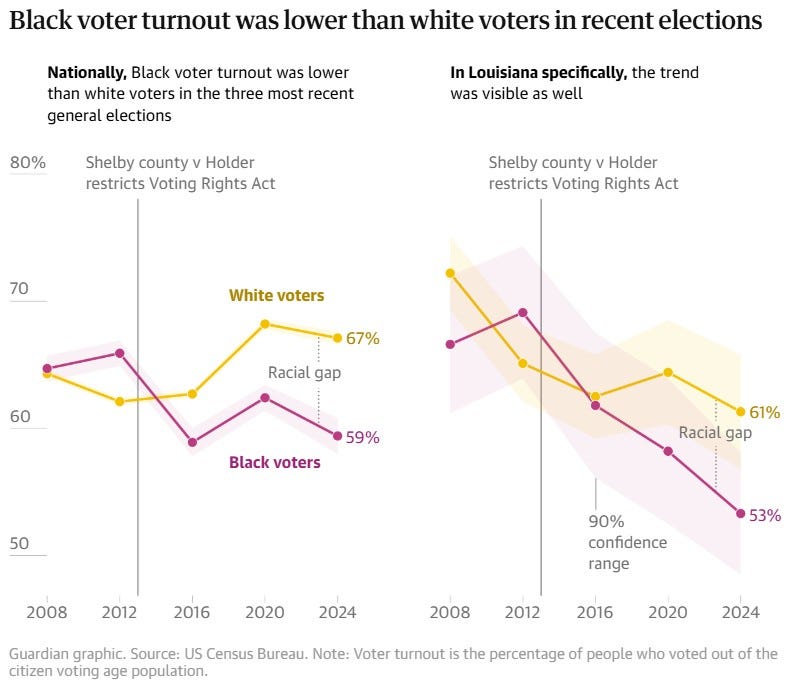
In fact, the gap between Black and White turnout is actually widening, a fact that the Brennan Center reported on in 2024 and the Guardian confirmed.
“They’re both cherry picking a particular year, they’re cherry picking a particular method and they’re ignoring this long term more concerning trend in the data,” said Christopher Warshaw, a professor at Georgetown University who studies elections.
By deliberately feeding cherry-picked data to the Court in their amicus brief, the Dept. of Justice provided the justification needed for six justices to determine that the protections of the Voting Rights Act should be overturned.
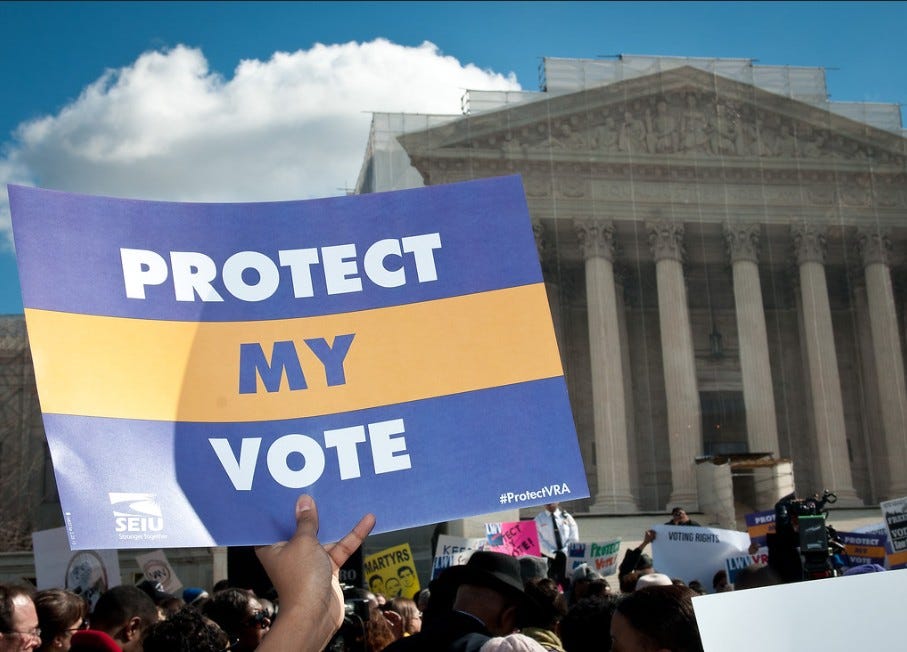
The effects of that decision cannot be overstated. Within days of the April 29 decision, a number of Southern states reacted with “breathtaking” speed:
In Louisiana, the governor issued an emergency declaration to stop an already in-process congressional election to allow the state legislature to redraw district maps to eliminate a predominantly Black (Democratic) seat.
In Alabama, the GOP-controlled legislature held a special session that voted during a flood evacuation to set aside the results of a completed primary later this year, if an injunction against redistricting is lifted by the courts later this year.
On Wednesday, the GOP majority in South Carolina voted to extend their legislative calendar to give them time to consider redistricting that would eliminate the only predominantly Black (Democratic) district, currently held by Rep. James Clyburn.
Mississippi, which has a GOP “trifecta” (control of both Houses and the Governorship), will meet later in May to consider redistricting.
On Thursday, the Tennessee legislature voted to eliminate the single predominantly Black (Democratic) district around Memphis, where approximately 2/3 of the 610,000 residents are Black.
When Merrick Garland appeared before the Senate for his confirmation hearings as President Biden’s pick for attorney general in 2021, he referenced the history of the Department of Justice in his opening remarks.
Celebrating DOJ's 150th year reminds us of the origins of the Department, which was founded during Reconstruction, in the aftermath of the Civil War, to secure the civil rights promised by the 13th, 14th and 15th Amendments. The first Attorney General appointed by President Grant to head the new Department led it in a concerted battle to protect black voting rights from the violence of white supremacists, successfully prosecuting hundreds of cases against members of the Ku Klux Klan.
Almost a century later, the Civil Rights Act of 1957 created the Department's Civil Rights Division, with the mission "to uphold the civil and constitutional rights of all Americans, particularly some of the most vulnerable members of our society." That mission remains urgent because we do not yet have equal justice.
It is clear that in spite of Constitutional amendments, federal legislation, and a century and a half of effort, we still do not have equal justice.
And under the current administration, it looks like the Department of Justice, which began as an attempt to implement provisions in the Constitution, has become an agency which instead is attempting to subvert it.
Resistance Action
This is an URGENT notice for anyone living in Alabama, Georgia, Idaho, Kentucky, or Oregon. (It applies to other states, too, but on a different timeline.)
All the states listed have primary elections coming up this month - most on May 19th. Some of you are probably going to vote at your local polling places.
Good. You’ll be OK as long as your registration is current (you HAVE been checking regularly, right?)
But if you were planning to vote by mail, DO NOT WAIT to drop your ballot in the mailbox. Mail it as early as you possibly can.
Why?
Because as of December 24, 2025, the US Postal Service changed its policy on postmarks so that they reflect the date mail is first processed at a regional facility, NOT the date it is dropped in a mailbox. That can mean a delay of several days between when you drop a piece of mail in the mailbox and when it is stamped with the postmark - and a late postmark may mean your ballot gets thrown out!
Here in Oregon, the state is telling voters that if we mail our ballot after 5/12, we should take it into a Post Office branch and ask workers to stamp it by hand. Dropping it in a USPS mailbox *does not* guarantee it will be postmarked in time to be accepted.
We can also take them in to election offices or drop them at official drop boxes, as well; those are safe right up to election day.
Your state may have different deadlines or rules, so you should check for yourself. My view is that it’s generally safer to vote as soon as you legally can.
However, given everything going on right now about Congressional districts and voting rights and all, don’t even THINK about skipping this primary.
And make sure you pay attention to who is running for your state legislature, also - because they’re the ones who are going to be deciding what to do in the face of the dismantling of the Voting Rights Act by the Supreme Court.
That’s all for tonight. This has been a tough week, but we WILL get through it as long as we keep working together. Just remember to stay strong, stay loud, and never, EVER give up!